
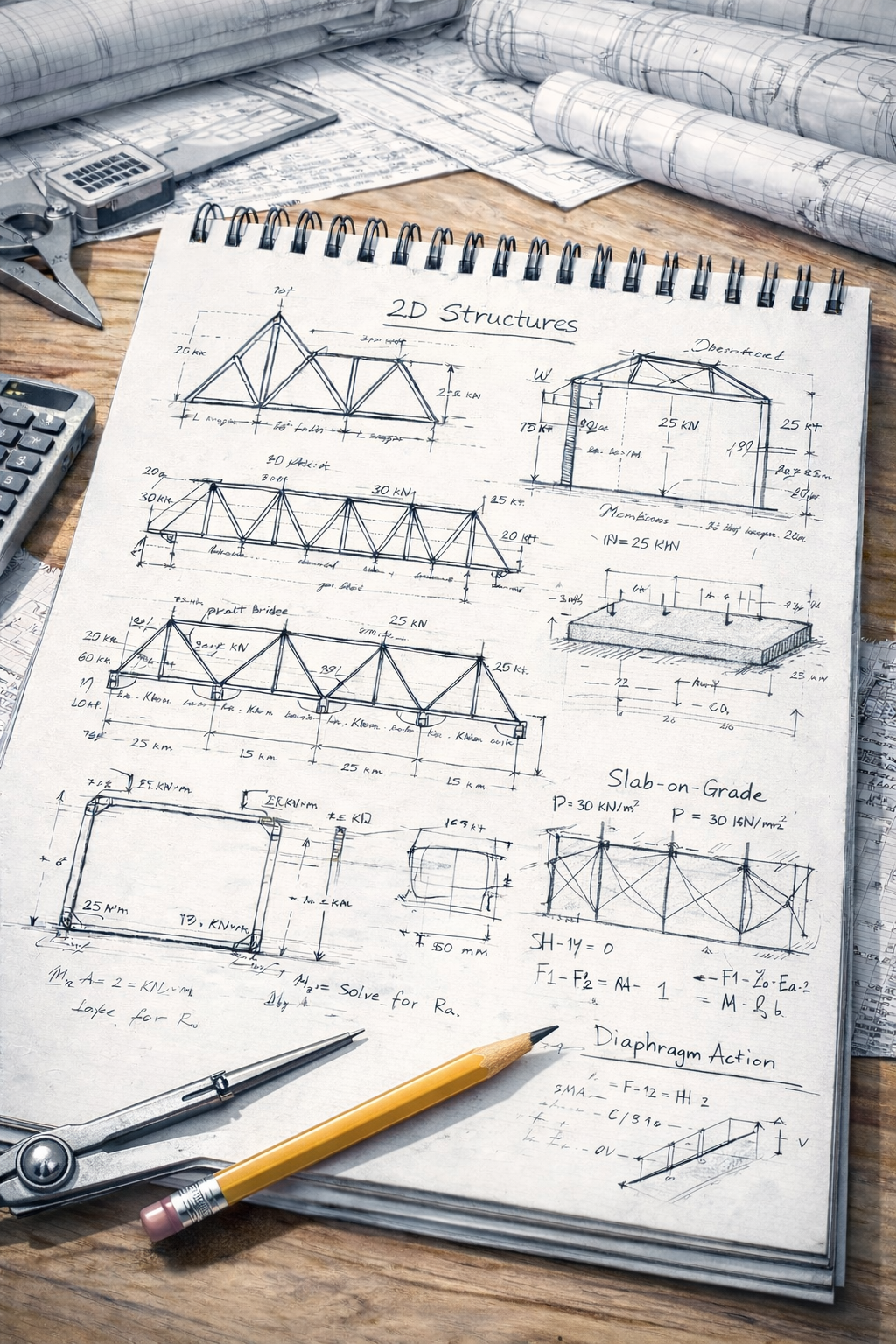
Two-Dimentional (2D) Structures
Planar systems governed by localized behavior, dynamics, and support conditions
-
Two-dimensional structural systems are commonly used in industrial facilities where loads and structural response are primarily contained within a single plane. Although these structures may appear simpler than three-dimensional frames or shell systems, their behavior is often governed by localized effects, dynamic actions, and sensitivity to support conditions.
Typical applications
Conveyors and conveyor galleries
Monorails and lifting systems
Flat slabs and planar frames
Wall-supported or line-supported structures
-
The performance of predominantly two-dimensional structures is governed by how loads are introduced, transferred, and restrained within the plane of action. In many cases, serviceability, vibration, and connection behavior control design adequacy more than member strength.
Key governing aspects include:
Local bending and shear behavior
Dynamic amplification and vibration sensitivity
Boundary conditions and support stiffness
Load eccentricities and secondary effects
Because these systems are often part of larger assemblies, their behavior is strongly influenced by what they are connected to.
-
Challenges associated with two-dimensional structures often stem from assumptions of simplicity that do not reflect actual behavior, including:
Idealization of supports that are flexible or partially restrained
Underestimation of dynamic effects from moving equipment
Neglect of load eccentricities and connection detailing
Inconsistent assumptions between structural and mechanical systems
These issues are frequently identified only after operational problems arise.
-
Deficiencies in two-dimensional structures most often manifest as serviceability or performance issues rather than sudden collapse, such as:
Excessive deflections affecting alignment or operation
Vibration leading to discomfort, fatigue, or equipment malfunction
Progressive deterioration at connections or supports
Local overstressing due to unintended load redistribution
While not always immediately critical, these issues can significantly affect reliability and maintenance requirements.
-
Rezali supports two-dimensional structural systems through careful definition of load cases, realistic representation of supports, and evaluation of dynamic and serviceability criteria. Particular attention is given to how these structures interact with adjacent systems and operational demands.
Typical involvement includes:
Structural analysis with realistic boundary conditions
Evaluation of dynamic response and vibration behavior
Review of connection detailing and load introduction
Independent assessment of serviceability performance
-
Where appropriate, this section may include:
Simplified free-body diagrams
Deflection or vibration mode sketches
De-identified project photographs highlighting support conditions
Illustrations should clarify behavior rather than document form.
-
Experience with two-dimensional structures consistently reinforces that:
Apparent simplicity often conceals governing complexity
Support assumptions strongly influence behavior
Dynamic effects should be addressed early, not reactively
Serviceability criteria are central to long-term performance
These lessons guide Rezali’s approach to both design and review.
-
Some industrial systems cannot be categorized as purely planar or three-dimensional. The next section addresses hybrid structures, where multiple structural behaviors interact within a single system.