
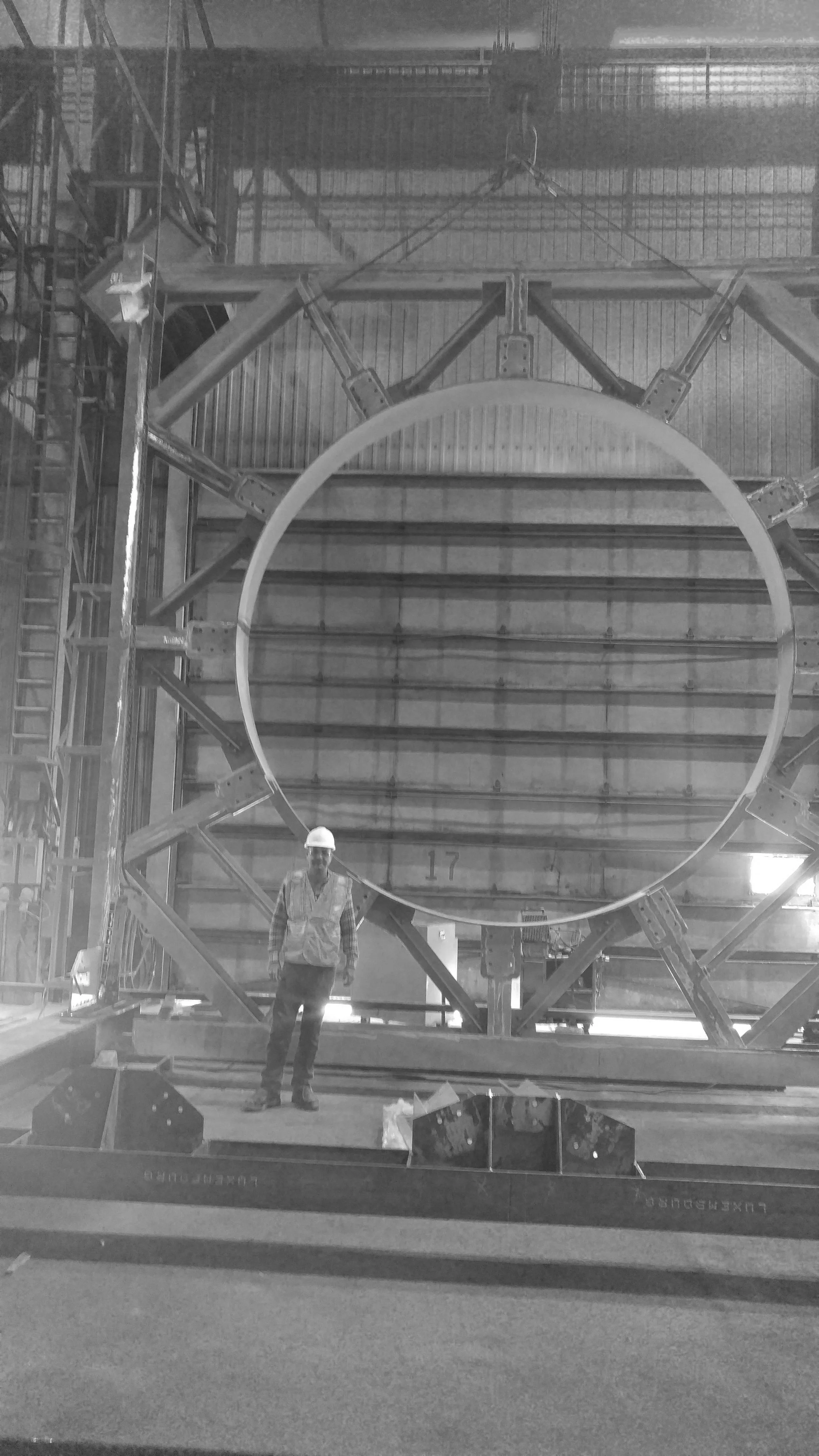
Engineering
grounded in practice, responsibility, and mutual trust.
Who is Rezali?
Rezali is an engineering consulting firm built on practice, accountability, and technical depth — shaped directly by the professional journey of its founder, Ali Rezaiefar, PhD., Ing., P.Eng.
Rezali was not built as a generic consultancy. It was established as a direct extension of hands-on engineering practice developed over more than 15 years across industrial projects, research environments, construction sites, and regulatory institutions in Canada and internationally. The firm’s backbone is not marketing language or abstract methodology, but lived engineering experience — guided by mentorship, rigor, and responsibility.
From the start, Rezali was designed to operate the way real engineering must operate: with clear technical ownership, traceable decisions, and a constant link between design intent and field reality. The firm exists to serve clients who need more than drawings or calculations — clients who need defensible engineering judgment, clear risk awareness, and work that can stand up to review by peers, auditors, contractors, and authorities. This is where “accountability” becomes practical: assumptions are stated, interfaces are managed, uncertainties are tracked, and decisions are documented in a way that remains coherent months/years/decades later when questions inevitably arise.
The foundation of Rezali is a career built at the intersection of theory and execution. Over more than 25 years, Ali Rezaiefar’s work has spanned industrial design challenges, applied research, and on-the-ground construction support — including situations where engineering decisions directly affected safety, cost, schedule, and long-term operability. That range matters. It means Rezali approaches engineering problems with a full lifecycle mindset: how the structure will be built, how it will behave, how it will be inspected, and how it will be maintained. The objective is not to produce “deliverables,” but to produce outcomes that hold under real constraints and real scrutiny.
Rezali’s consulting style is therefore deliberately practice-driven. Engineering is treated as a disciplined craft: confirm requirements, understand the operational context, identify governing codes and standards, verify load paths and failure modes, and communicate results in a way that construction teams can actually use. Where many firms rely on broad templates, Rezali emphasizes project-specific thinking — especially in industrial environments where small details (connections, tolerances, erection sequencing, interfaces with equipment, vibration, corrosion, fatigue, or thermal effects) can dominate performance. Technical depth is not presented as a slogan; it is reflected in how work is structured, checked, and delivered.
Just as importantly, Rezali was built around responsibility — not only to the client, but to the public, to the field teams, and to the professional obligations that come with engineering practice in Canada. That responsibility shows up in how Rezali handles uncertainty and risk. When information is incomplete, it is flagged. When a design choice involves trade-offs, they are made explicit. When site conditions diverge from assumptions, the engineering response is structured, fast, and documented. This is the difference between “consulting” as a service and engineering as a duty: the work must remain coherent when conditions change and when accountability becomes real.
In short, Rezali exists to deliver engineering that is technically solid, field-aware, and owned from end to end. It is a firm shaped by real projects, real constraints, and real responsibility — built to support industrial stakeholders who value clarity, rigor, and decisions that can be defended, constructed, and trusted.
-
Every engineering practice is the result of transmission. Rezali openly acknowledges the mentors and professional environments that shaped its standards and judgment.
A central influence has been Mr. Kris Rosiak, ing., whose approach to structural engineering emphasized clarity of responsibility, respect for codes and constructability, and the role of engineering judgment beyond calculations. His mentorship helped shape Rezali’s approach to industrial structures as systems that must work — not only on paper, but in fabrication, erection, operation, and inspection.
Another key influence is Mr. Henry Nowodworski, ing., former principal at Strudes Inc., where Ali Rezaiefar worked as a structural engineer on complex steel, aluminum, and reinforced concrete projects. This period grounded Rezali’s engineering DNA in real-world industrial constraints: cranes, silos, ducts, heavy connections, and non-standard structures governed by CSA, NBCC, and CISC requirements.
Rezali’s work today reflects these mentorship paths — rigorous, pragmatic, and accountable.
-
Rezali bridges applied research and professional engineering practice.
Ali Rezaiefar’s background includes:
Doctoral and master’s research in thin-walled industrial structures, seismic behavior, vibration, and nonlinear structural response
Peer-reviewed publications in international journals and conferences
Teaching and laboratory instruction in steel and concrete design at Concordia University
Research fellowship work with Fives Solios, producing design-oriented research used directly in industry
This research foundation is not academic abstraction. At Rezali, research is used only where it strengthens design decisions, reduces uncertainty, or justifies departures from standard solutions — always with constructability and code compliance as anchors.
-
Between 2018 and 2025, Ali Rezaiefar served as a Research Council Officer at the National Research Council Canada (NRC) within the Canadian Construction Materials Centre (CCMC).
This role provided a rare, system-level understanding of:
How building codes are interpreted and enforced
How innovative products are evaluated for compliance
How engineers, manufacturers, regulators, and authorities interact
Rezali benefits directly from this perspective. The firm designs and reviews structures with a clear understanding of how decisions will be examined — by reviewers, auditors, inspectors, and authorities having jurisdiction.
-
Rezali treats quality management as an engineering discipline, not an administrative add-on.
The firm has:
Authored ISO 9001-aligned Quality Assurance and Quality Control manuals
Developed project-specific QC systems for industrial steel and custom fabrication
Supported audit readiness, document control, and subcontractor coordination
Integrated quality thinking directly into engineering workflows
This approach reflects Rezali’s belief that quality failures are rarely accidental — they are almost always structural, procedural, or organizational.
-
Before engineering titles and credentials, Rezali’s foundation was built through real work — construction labor, food service, cleaning, coaching, drafting, and site work. These experiences instilled respect for trades, workers, schedules, safety, and human limits.
That grounding remains visible in Rezali’s engineering philosophy:
Designs must be buildable
Calculations must correspond to reality
Engineers are accountable to the people who execute their work
Meet Krzysztof (Kris) Rosiak, ing.
An Engineering Titan
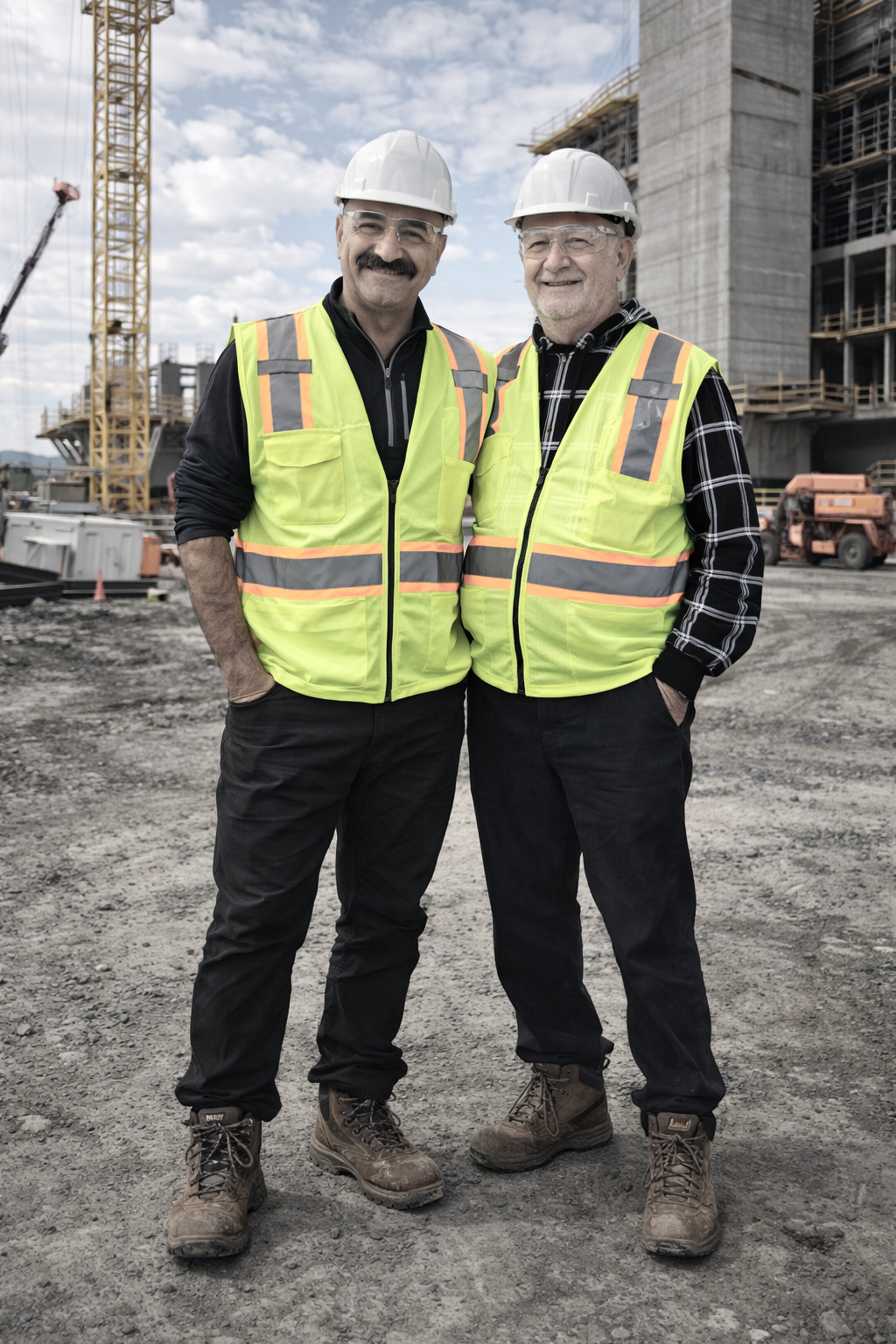
Mr. Kris Rosiak, ing., is a key mentor behind Rezali’s engineering foundation. His influence is not limited to technical knowledge — it is rooted in how engineering should be practiced: with responsibility, constructability, and professional judgment at the center of every decision. This mindset continues to shape Rezali’s approach to structural engineering, where solutions are not based on “best guesses” or convenient assumptions, but on codes, proven experience, and the real-world constraints that govern industrial projects.
Kris helped define the standard of rigor that Rezali aims to maintain: engineering that can be built, verified, reviewed, and trusted. In industrial environments, the correct answer is rarely just the one that works on paper — it must also account for fabrication tolerances, erection realities, access for welding and bolting, sequence constraints, site safety, operational interfaces, and long-term service conditions. Kris’s emphasis on constructability means that Rezali treats field feasibility as an engineering requirement, not a downstream problem for contractors to solve. The result is work that is clearer, safer, and more resilient when exposed to schedule pressure and site variability.
His contribution is also deeply tied to judgment — the part of engineering that cannot be automated or reduced to formulas. Judgment is what turns analysis into decision-making: identifying what truly governs, recognizing when a result is “technically correct but practically wrong,” and distinguishing between acceptable simplifications and dangerous ones. Kris has spent decades refining that skill in the industrial world, where the cost of misjudgment can be high and where solutions must survive scrutiny from inspectors, fabricators, construction managers, and engineers of record. That depth of perspective is rare, and it is one of the reasons Rezali’s engineering culture prioritizes clarity and defensibility over speed for its own sake.
Importantly, Kris is not only a historic influence on Rezali — he remains an active collaborator today. In a semi-retired capacity, he works with Rezali as a senior internal technical authority, providing oversight and strategic guidance when it matters most. His involvement scales with complexity: sometimes offering a targeted review of critical details, sometimes acting as a broader sounding board for structural concepts, risk decisions, or sensitive interfaces. This flexible engagement model strengthens Rezali’s ability to deliver confidently across a wide range of project conditions, without inflating process or slowing execution unnecessarily.
With more than 40 years of industrial experience, Kris brings a level of insight that very few firms in Québec or Canada can claim. That experience is not presented as a credential — it is applied directly to the work: validating assumptions, pressure-testing design approaches, anticipating constructability traps, and ensuring that final recommendations remain aligned with both the code framework and the reality of industrial construction. For Rezali, this relationship is a cornerstone: a living source of mentorship, accountability, and high-level technical judgment that continues to elevate the firm’s standards on every project.
What Sets Us Apart
Objectivity as the Main Rule
Rezali’s work is governed first and foremost by objectivity. Engineering decisions are built on verifiable facts, applicable codes, sound analysis, and professional judgment — not on preferences, pressure, convenience, or the loudest voice in the room. This principle is not a slogan; it is a working rule that shapes how we assess problems, communicate risk, and stand behind our conclusions.
Every mandate is approached with a disciplined separation between technical assessment and external interests. Clients may have priorities related to cost, schedule, procurement, or operational constraints — and those priorities are real. But they do not replace engineering reality. Rezali’s role is to clearly identify what is safe, compliant, buildable, and technically justified, then explain the trade-offs in plain language so decisions can be made responsibly. When something is uncertain, we say it. When something is unsupported, we don’t dress it up. When a condition requires attention, we document it and define the path forward.
Objectivity also means that Rezali treats assumptions as engineering decisions. Loads, boundary conditions, material properties, tolerances, existing-condition data, and construction sequencing are not “background details” — they are often what govern the final outcome. We make assumptions explicit, track them, and confirm them where possible through drawings, site information, inspection data, or client-provided records. This approach reduces surprises downstream and strengthens the defensibility of the work during review, fabrication, construction, and audits.
Ultimately, Rezali’s commitment to objectivity protects everyone involved: the client, the contractor, the public, and the engineer. It leads to work that can withstand scrutiny from peers and authorities, remain coherent when conditions change, and hold up months later when questions resurface. That is the standard Rezali aims to bring to every structural decision — clear, unbiased, and technically grounded.
Engineering Vision, Paired with Available Tools
Rezali approaches every engineering problem with a clear technical vision before selecting tools, methods, or software. The objective is to understand the structure, the governing behaviors, and the real constraints of the project first — then choose the most appropriate means to validate, document, and deliver the solution. In other words: tools serve the engineering, not the other way around.
Analysis techniques, numerical models, and digital platforms are treated as means — not drivers — of engineering decisions. Software can calculate, simulate, and organize information, but it cannot define intent, judge relevance, or recognize when a result is technically “clean” yet practically wrong. Rezali begins by framing the problem correctly: identifying the load paths, failure modes, interfaces, constructability constraints, service conditions, and applicable codes. Only after that does modeling become valuable — as a targeted way to answer specific questions with the right level of confidence.
Because industrial projects vary widely in risk and uncertainty, Rezali chooses the level of modeling and documentation deliberately. Not every situation requires a complex finite element model, and not every situation can be solved responsibly with a simple check. The approach is scaled based on:
The nature of the problem (new design, modification, evaluation of existing conditions, temporary works, repairs)
The consequences of failure (safety, operability, downtime, regulatory exposure, reputational risk)
The quality of available information (as-built reliability, inspection data, site constraints, material traceability)
The required deliverables (permit-level packages, fabrication drawings support, RFI responses, audit-ready documentation)
This mindset produces work that is both rigorous and efficient: rigorous because the engineering logic is explicit and defensible, efficient because time is spent where it actually reduces risk and uncertainty. The result is not “more modeling,” but better modeling — focused, justified, and aligned with what the project truly needs.
An Interactive Learning Curve
Rezali is built around continuous learning — not as an abstract value, but as an integral part of engineering practice. Every project, design review, site observation, and unexpected constraint creates feedback. Rezali treats that feedback as engineering data: captured, reflected on, and used to improve the next decision rather than repeating the same patterns under new project numbers.
Engineering is an evolving discipline. Codes update, industry practices shift, fabrication methods change, and clients face new operational realities. But beyond external change, real learning happens in the details: a connection that was theoretically adequate but difficult to install, a tolerance issue that required a field adjustment, a misunderstanding at an interface that created rework, or a risk that wasn’t visible until construction sequencing began. Rezali pays attention to these moments because they are where engineering maturity is built.
This is why experience at Rezali is accumulated deliberately and lessons are retained structurally — not just in someone’s memory. We aim to convert day-to-day project feedback into stronger internal standards: clearer checklists, better detailing habits, improved review routines, and sharper risk awareness during early design. The objective is simple: each mandate should leave Rezali technically better than before, and each client should benefit from the cumulative learning embedded in how we work.
That is what “interactive learning” means at Rezali: a continuous loop between analysis and reality, between office decisions and field outcomes — turning projects into long-term engineering capability.