
When the structure starts to dance
Vibration, resonance, and fatigue in industrial process structures
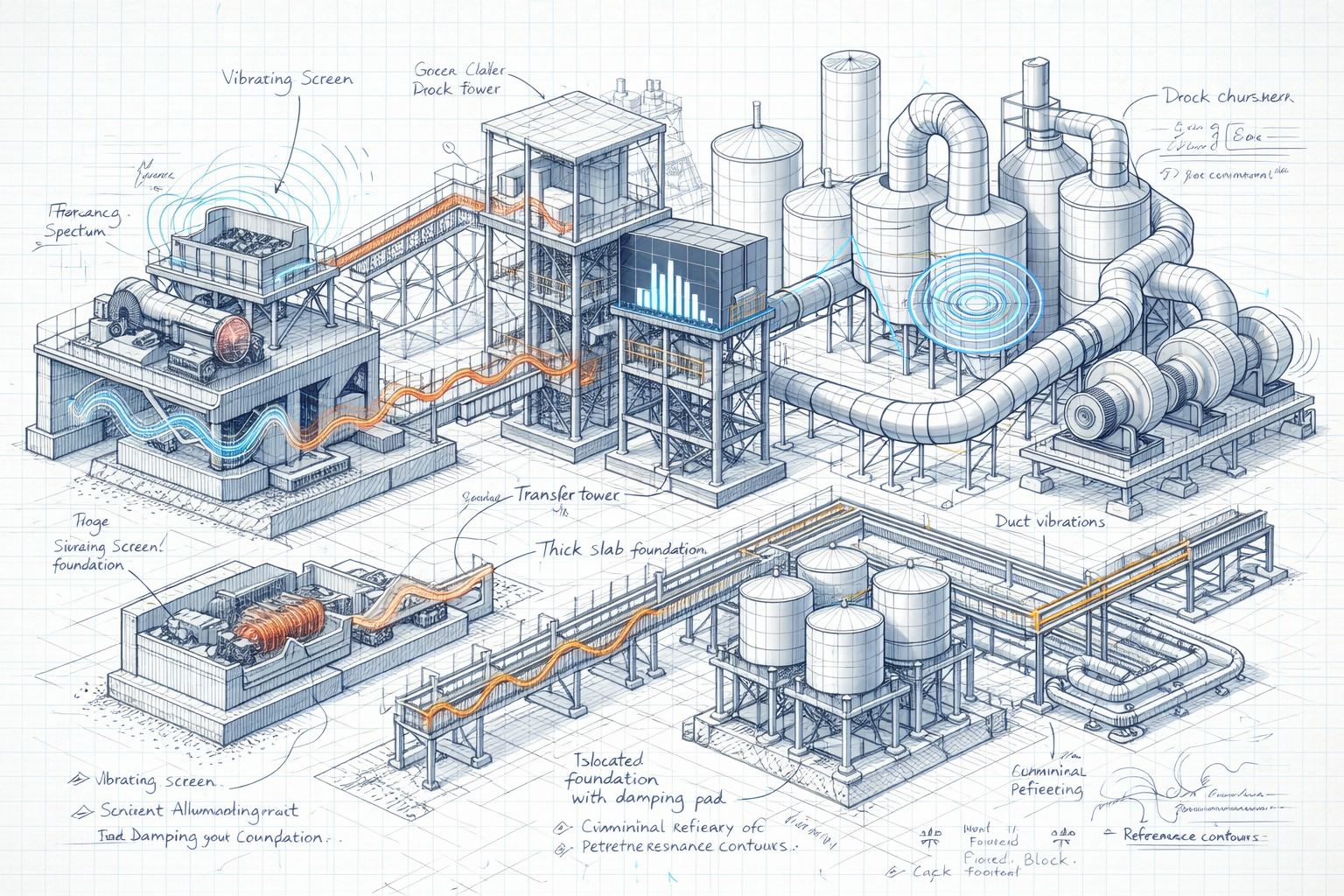
This image was generated by AI via prompt by the author.
The Frequency-First Mindset
Structural design traditionally begins with loads. We quantify forces, apply combinations, and verify that stresses and deflections remain within acceptable limits. This approach is fundamental and unavoidable. But in industrial facilities, it addresses only part of the problem.
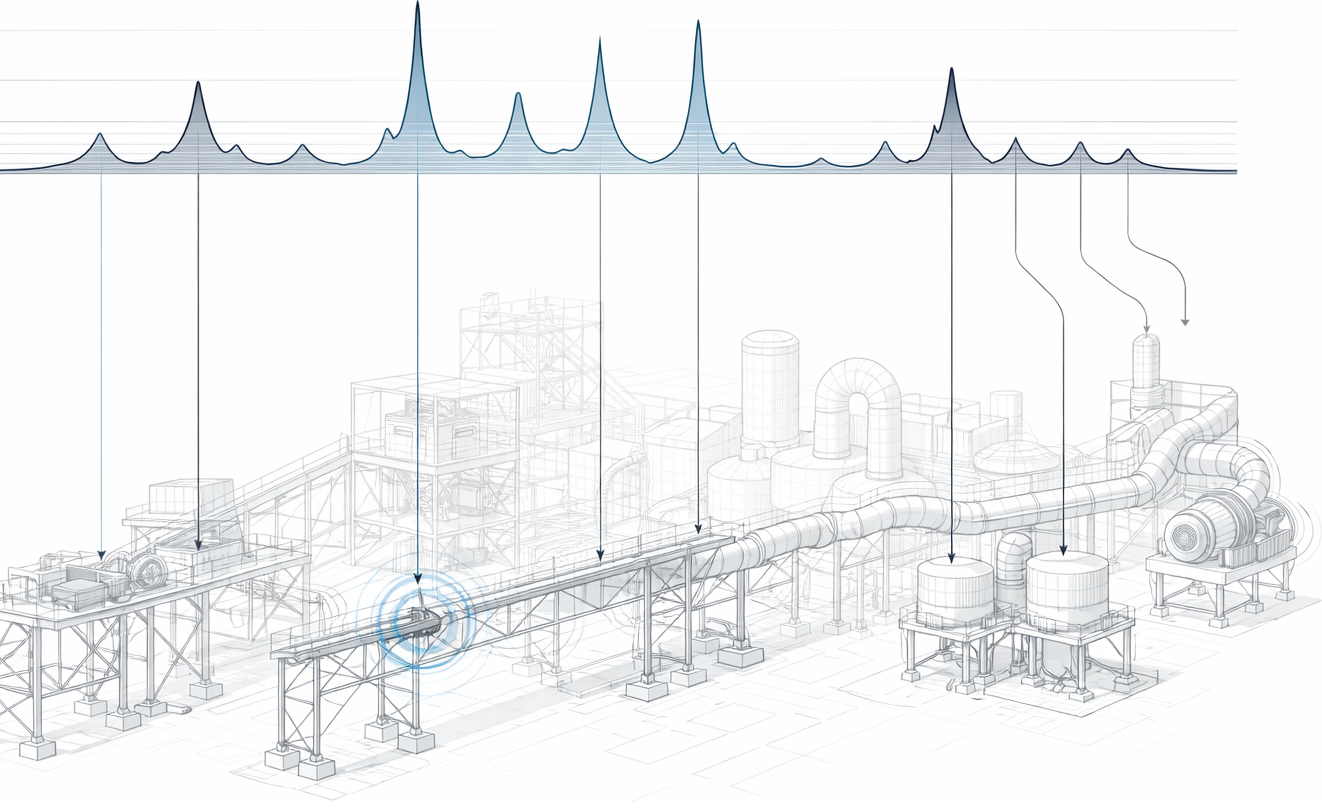
Vibrations in industrial facilities could be presented via spectrum in a frequency-first mindset
Vibration does not originate from static load. It originates from energy introduced at specific frequencies.
Every operating industrial plant exists within a limited and identifiable frequency environment. Rotating equipment produces excitation at running speed and harmonics. Fans introduce blade-pass frequencies. Conveyors generate periodic forcing linked to belt speed and idler spacing. Flowing fluids create pulsations, turbulence, and vortex shedding. Impact-driven systems add broadband energy through intermittent contact and material discharge.
From a frequency-first perspective, the first question is not how much force is applied, but what frequencies are present, and how persistent they are.
Structures do not respond equally to all excitation. They are selective. Each component — from a global frame to a thin plate, a handrail, or a welded attachment — has its own dynamic characteristics. When excitation frequencies align with a structural natural frequency, even modest energy input can result in sustained vibration.
This is why vibration-related problems so often appear in locations where static stress is low. The governing mechanism is not overload, but repetition. A stress range that is insignificant in a single cycle becomes critical when it is applied millions of times. Fatigue, noise, loosening of connections, and serviceability issues emerge long before strength limits are approached.
A frequency-first mindset also changes how engineers interpret stiffness. Increasing stiffness may shift natural frequencies upward, but it does not eliminate dynamic response. In some cases, it moves the structure directly into a more energetic excitation range. Damping, mass distribution, and load paths become just as important as member size.
Equally important is recognizing that vibration problems are rarely confined to their source. Energy travels through structural connections, foundations, piping, and secondary steel. The component that vibrates visibly is often not the component that generates the excitation. Without a system-level view, mitigation efforts risk addressing symptoms rather than causes.
Adopting a frequency-first mindset does not replace conventional structural design. It complements it. It adds a layer of awareness that helps engineers anticipate where vibration is likely to appear, which elements are vulnerable, and why apparently minor details often govern long-term performance.
In industrial facilities, structures are never truly at rest. Designing for frequencies acknowledges that reality from the outset.
Sources, Paths, and Receivers
Vibration-related problems in industrial facilities are rarely caused by a single component acting in isolation. They emerge from systems, not parts. Understanding them requires separating three distinct roles that are often conflated during design and troubleshooting: the source, the path, and the receiver.
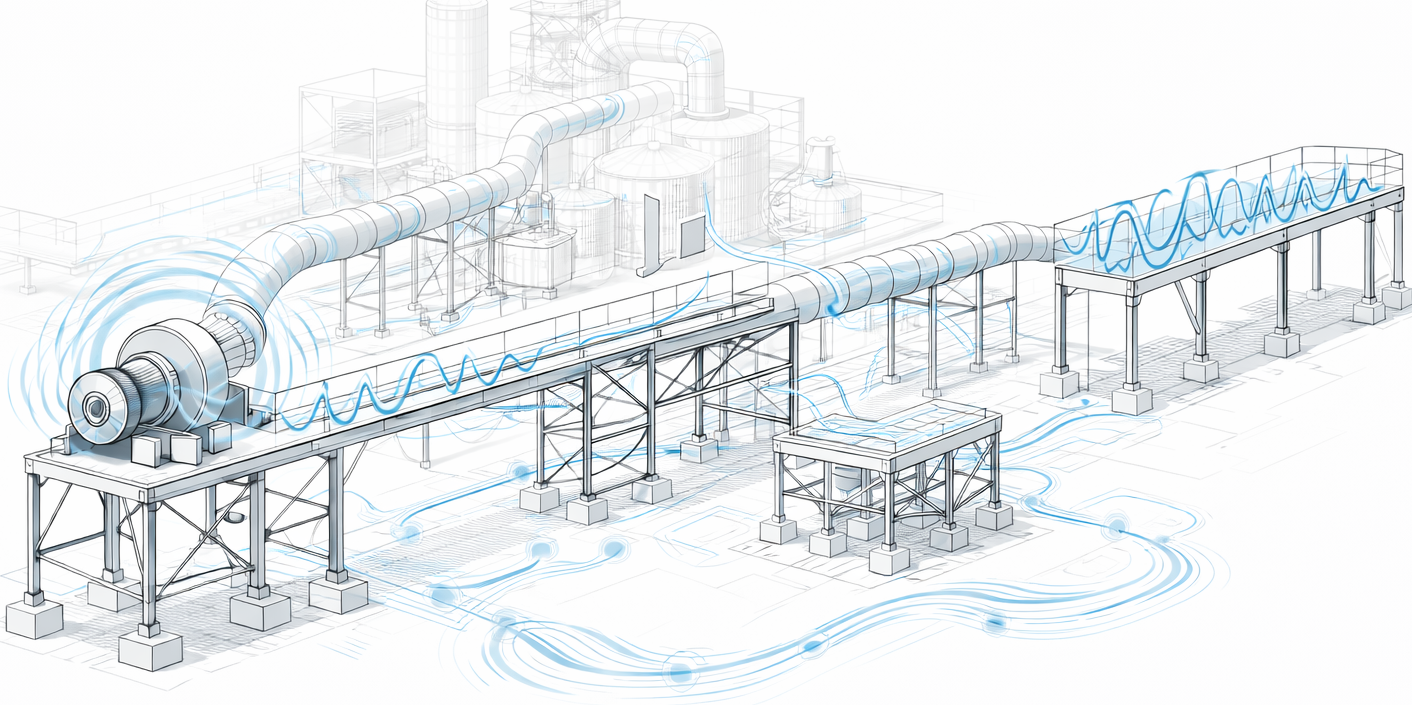
A vibrating source affects various structures in different ways through differernt propagation paths
The source is where dynamic energy is generated. In industrial plants, sources are abundant and predictable. Rotating equipment produces excitation at running speed and harmonics. Fans introduce blade-pass frequencies. Crushers, screens, and feeders generate forced vibration. Flowing fluids create pressure pulsations, turbulence, and vortex shedding. Material handling systems introduce impacts and intermittent loading. These sources are inherent to the process; they cannot be designed away.
The path is how that energy travels. Structural steel, foundations, ducts, piping, supports, and even soil transmit vibration with varying efficiency. Connections matter more than members. A stiff beam with a flexible connection behaves differently from a flexible beam with a stiff connection. Bolted joints, welded attachments, baseplates, grout layers, and soil-structure interaction all shape how energy propagates through the facility.
The receiver is where vibration manifests as a problem. This is often where cracks appear, noise is generated, instruments malfunction, or people feel discomfort. Crucially, the receiver is frequently not the source. A handrail vibrates because a fan operates. A pipe cracks because a screen runs continuously. A walkway becomes uncomfortable because a conveyor several bays away is loaded intermittently.
This separation explains why vibration issues are so often misdiagnosed. Engineers naturally focus on the component that moves visibly, but visible motion is not a reliable indicator of origin. In many cases, the receiver is merely the most dynamically sensitive element in the system — typically a secondary structure, thin plate, small-bore attachment, or welded detail with low mass and limited damping.
The source–path–receiver framework also explains why well-intentioned fixes sometimes fail. Adding stiffness at the receiver may reduce motion locally but leave the underlying excitation unchanged. Isolating a source without considering alternate transmission paths may simply redirect energy elsewhere. Effective mitigation requires understanding where the energy originates, how it travels, and why a particular component responds.
From a structural perspective, this framework shifts attention away from isolated stress checks and toward connectivity. It encourages engineers to ask different questions during design and assessment:
Which elements are dynamically linked?
Which connections provide efficient transmission paths?
Which components have low mass, low damping, or unfavorable natural frequencies?
In industrial facilities, vibration does not respect disciplinary boundaries. Mechanical, structural, and process systems are tightly coupled through physical connections. The source–path–receiver model provides a common language for navigating that coupling and for diagnosing vibration problems before they manifest as damage, noise, or operational complaints.
Once this system-level view is adopted, vibration ceases to be mysterious. It becomes traceable.
A Walk Through an Industrial Plant
With a frequency-first mindset and a system-level view of sources, paths, and receivers, vibration in industrial facilities becomes easier to anticipate. The most effective way to apply this understanding is to walk through a plant — not physically, but analytically — and observe where vibration is likely to originate, how it propagates, and which structures are most sensitive.
The following walk-through is based on an imaginary but realistic industrial facility, combining elements common to cement plants, aluminum refineries, and petrochemical installations. The specific process is less important than the structural patterns that repeat across industries.
Material Receiving and Raw Feed Systems
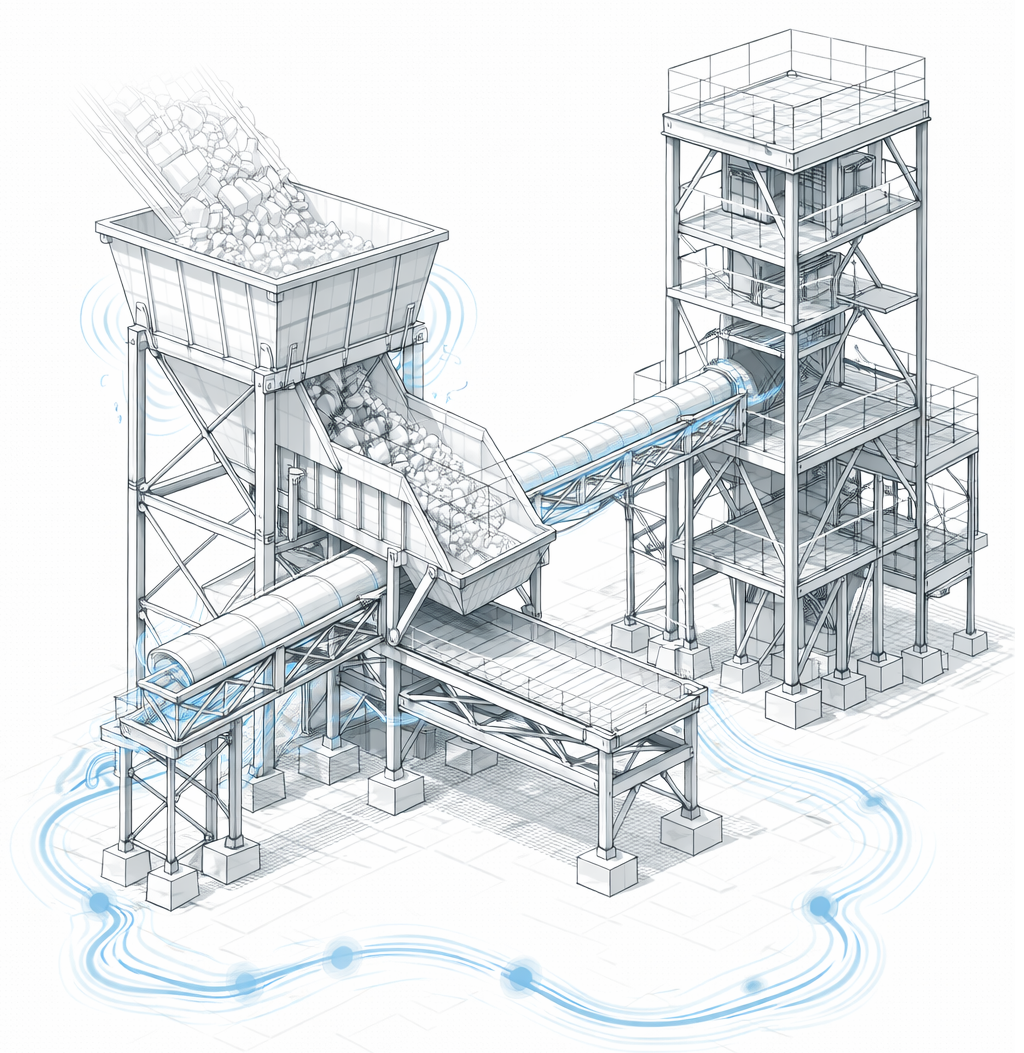
Raw material receiving areas are defined by impact, intermittency, and variability. Truck and rail dump hoppers, apron feeders, vibrating feeders, and grizzlies introduce dynamic loads that are neither smooth nor sinusoidal. These systems generate broadband excitation that readily couples with supporting structures.
Transfer towers and feed hoppers are particularly sensitive. They combine tall, relatively slender frames with localized mass concentrations and frequent changes in stiffness. Vibration problems often manifest at stiffener terminations, bracing connections, access platforms, and liner support systems. The governing mechanism is rarely global instability; it is local fatigue driven by repeated dynamic excitation.
Conveyors and Conveyor Galleries
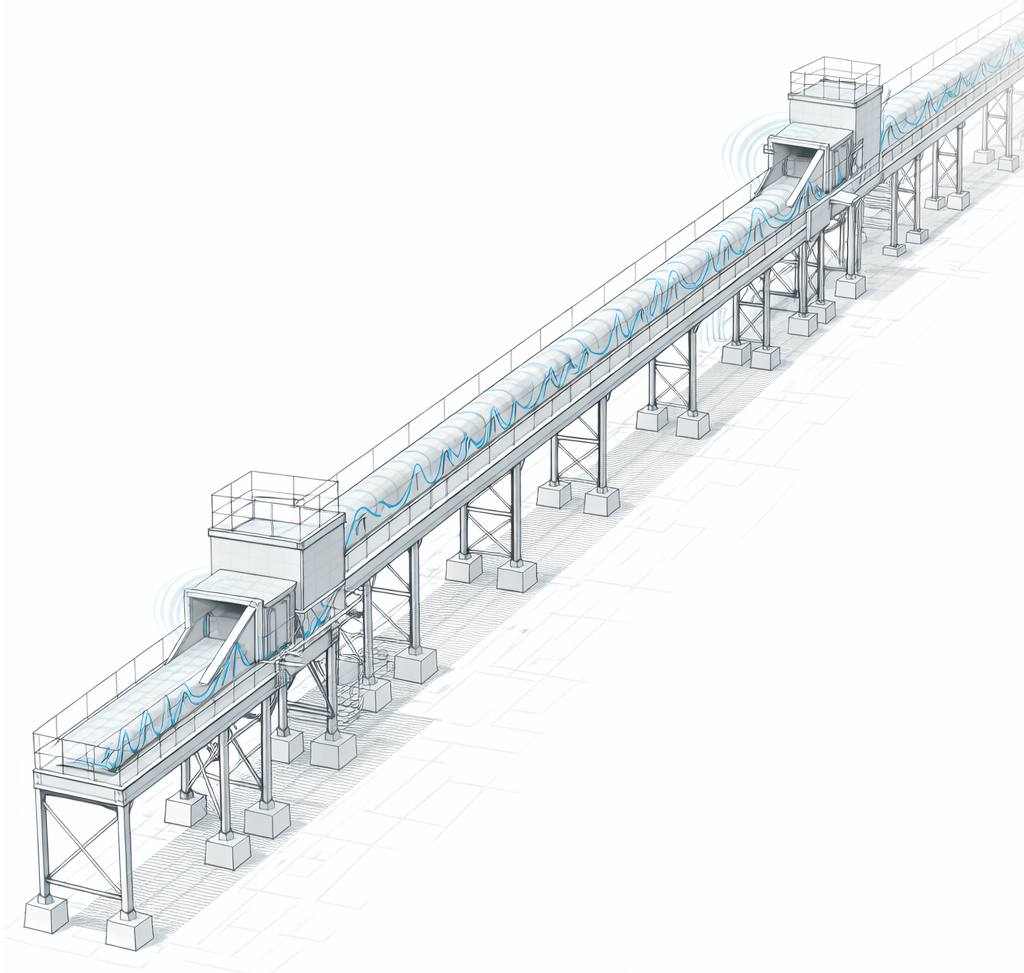
Conveyor systems dominate many industrial facilities in both length and structural modular repetition. Although individual conveyors may appear benign, their operation introduces persistent, periodic excitation tied to belt speed, idler spacing, and material loading.
Long conveyor galleries behave as distributed dynamic systems. Global modes of the supporting truss or frame interact with local modes of deck plates, handrails, cable trays, and cladding. Transfer points amplify these effects by introducing impacts, flow instabilities, and asymmetric loading.
In fine-powder handling systems — such as alumina or cement raw meal — the interaction between material flow and structure can produce low-amplitude but highly persistent vibration. These conditions are ideal for high-cycle fatigue in secondary elements, even when primary members remain well within allowable stress limits.
Fans, Ducts, Cyclones, and Baghouses
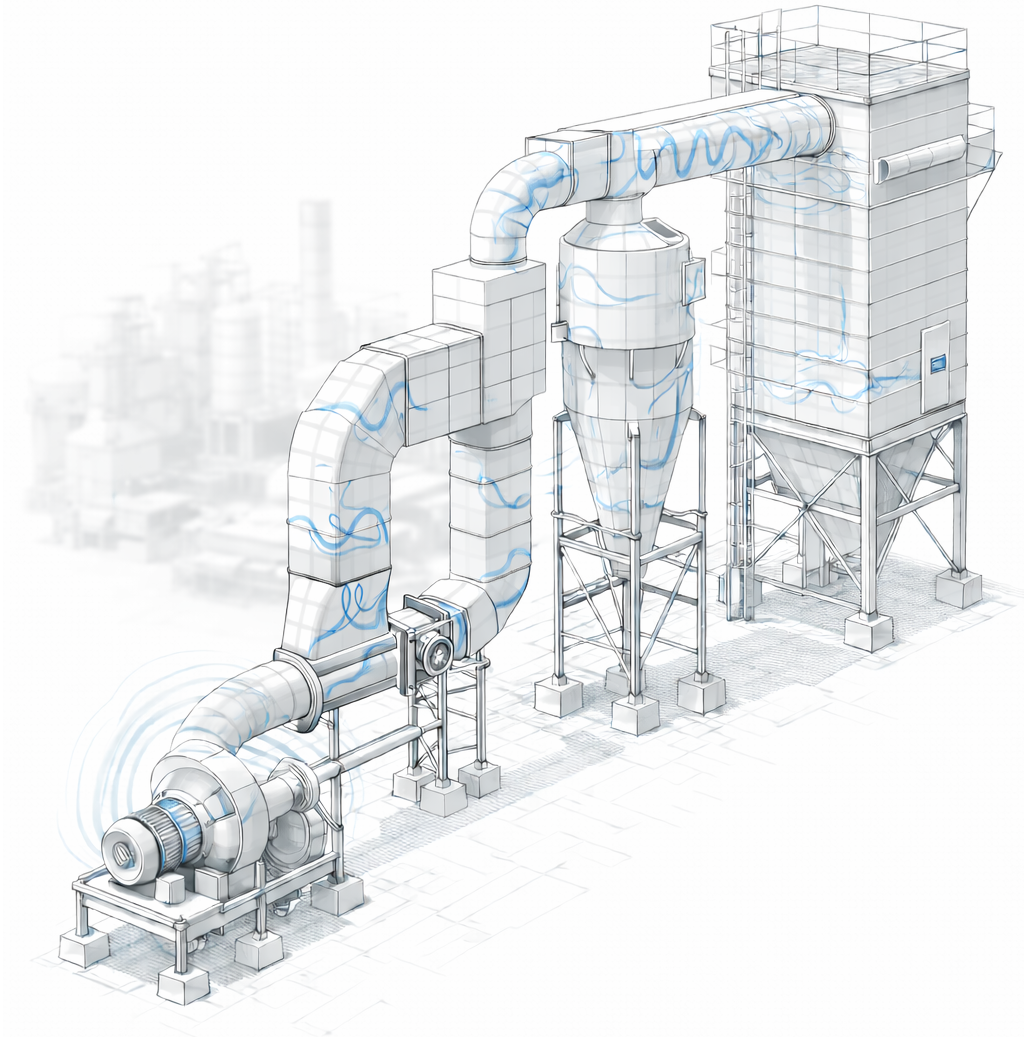
Air and gas handling systems introduce some of the most deceptive vibration problems in industrial plants. Large fans generate excitation at running speed and blade-pass frequency, often with narrow-band spectral content. Thin-walled ducts, cyclones, and baghouse casings provide low mass and limited damping, making them dynamically sensitive.
Vibration in these systems frequently presents as noise rather than visible motion. Local panel resonance, shell modes, and interaction with internal acoustic fields can lead to fatigue cracking at welds, support lugs, and nozzle connections. These effects are often intensified at changes in geometry or stiffness, such as transitions, access doors, and stiffener runouts.
The structural concern extends beyond the duct itself. Vibration is readily transmitted to supporting steel, platforms, and adjacent pipe racks, where it may reappear as serviceability or comfort issues.
Crushers, Screens, and Milling Equipment
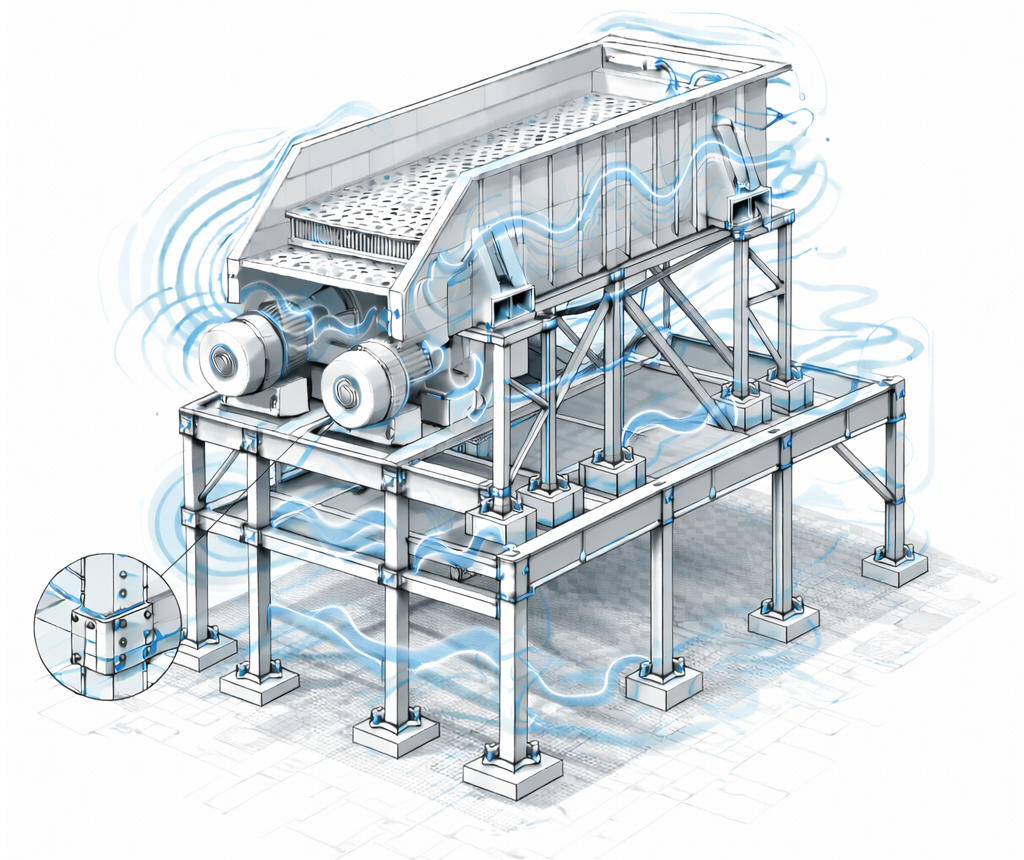
Crushers, vibrating screens, and mills represent classical cases of forced vibration. These machines operate within defined frequency ranges and transmit significant dynamic forces to their supporting structures.
Supporting frames and platforms must manage not only strength but also dynamic compatibility. Global frame modes, local member vibration, and foundation interaction all influence response. Inadequate separation between operating frequencies and structural natural frequencies can result in excessive vibration amplitudes, bolt loosening, weld fatigue, and accelerated wear.
At material discharge points — such as receiver hoppers or batching plant feed systems — dynamic effects are often compounded by impact loading and flow irregularities, extending vibration problems beyond the immediate equipment support.
Silos, Bins, and Hoppers
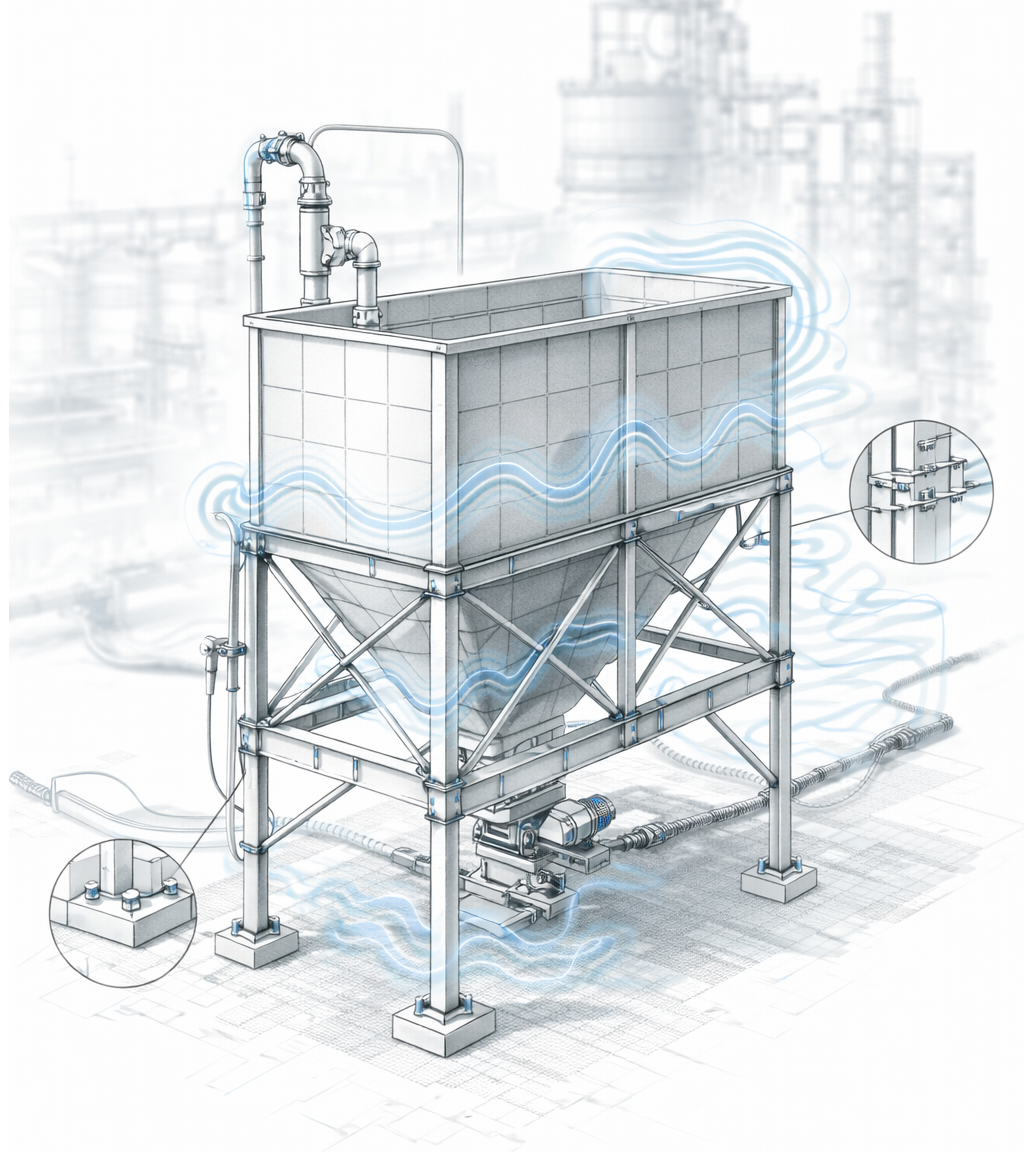
Storage structures introduce a different class of vibration challenges. The dynamic behavior of silos, bins, and hoppers depends not only on structural configuration but also on fill level, material properties, and discharge behavior.
Flow-induced phenomena such as arching, ratholing, and stick-slip motion introduce intermittent excitation. Aeration systems and bin activators further complicate the frequency environment. As material levels change, natural frequencies shift, sometimes bringing the structure into resonance under operating conditions that were not critical during design.
Vibration-related issues in these systems commonly appear at discharge transitions, stiffener intersections, and attachments supporting liners, aeration piping, or instrumentation.
Secondary Structures and Unexpected Receivers
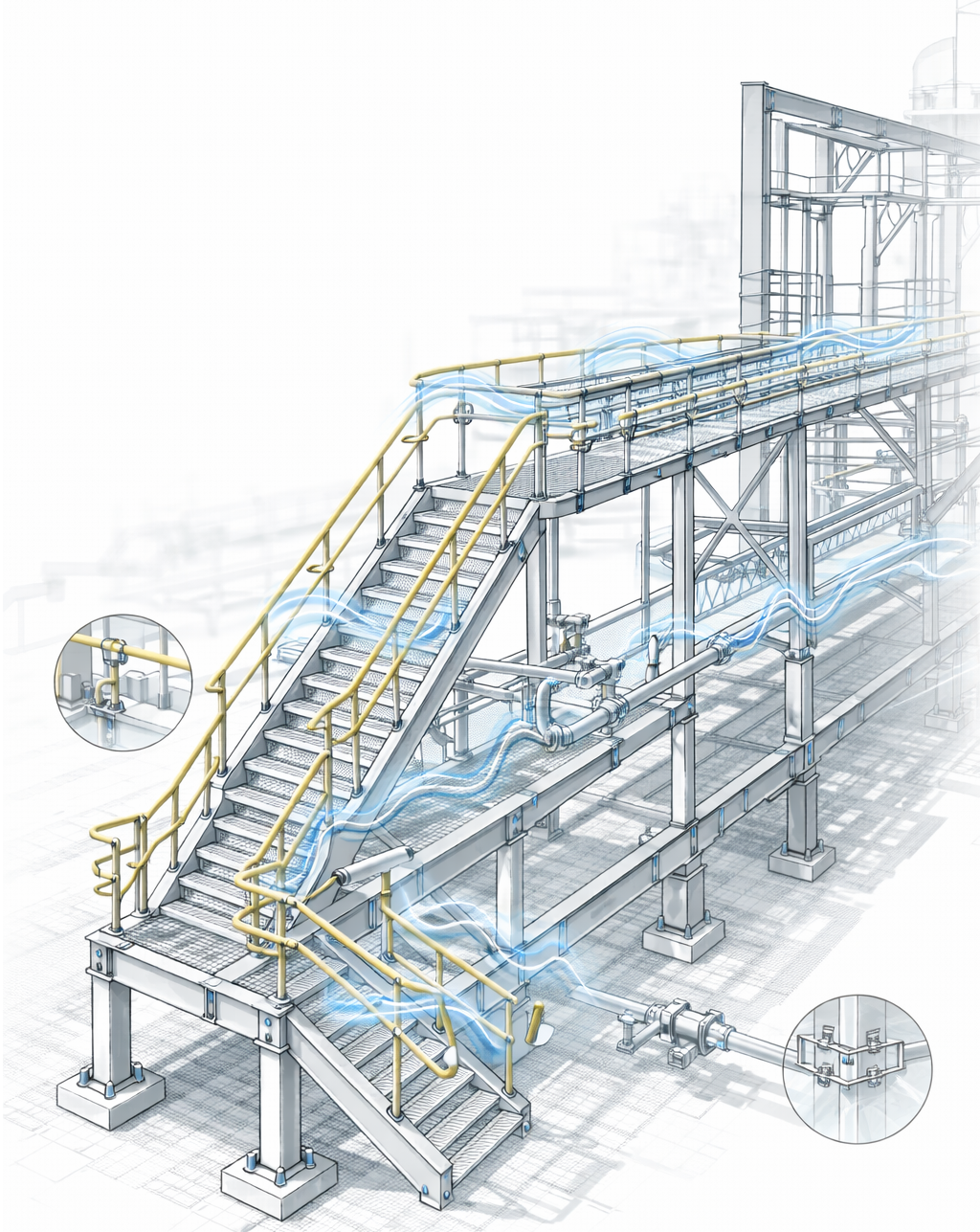
Not all vibration problems originate in major equipment or primary structures. Walkways, stairs, handrails, cable trays, and small-bore piping frequently act as receivers due to their low mass, limited damping, and proximity to excitation sources.
These elements often govern perception. Operators feel vibration through floors and handrails long before structural damage occurs. Noise generated by vibrating secondary elements can drive complaints and trigger investigations, even when measured stresses remain low.
Recognizing these components as part of the dynamic system — rather than as accessories — is essential for effective vibration management.
Across the plant, the pattern is consistent. Vibration arises from predictable sources, travels through physical connections, and reveals itself where structural response is most favorable. A systematic walk-through, guided by frequency awareness and system connectivity, allows engineers to identify risk areas early — often before any analysis is performed.
When Vibration Becomes a Problem
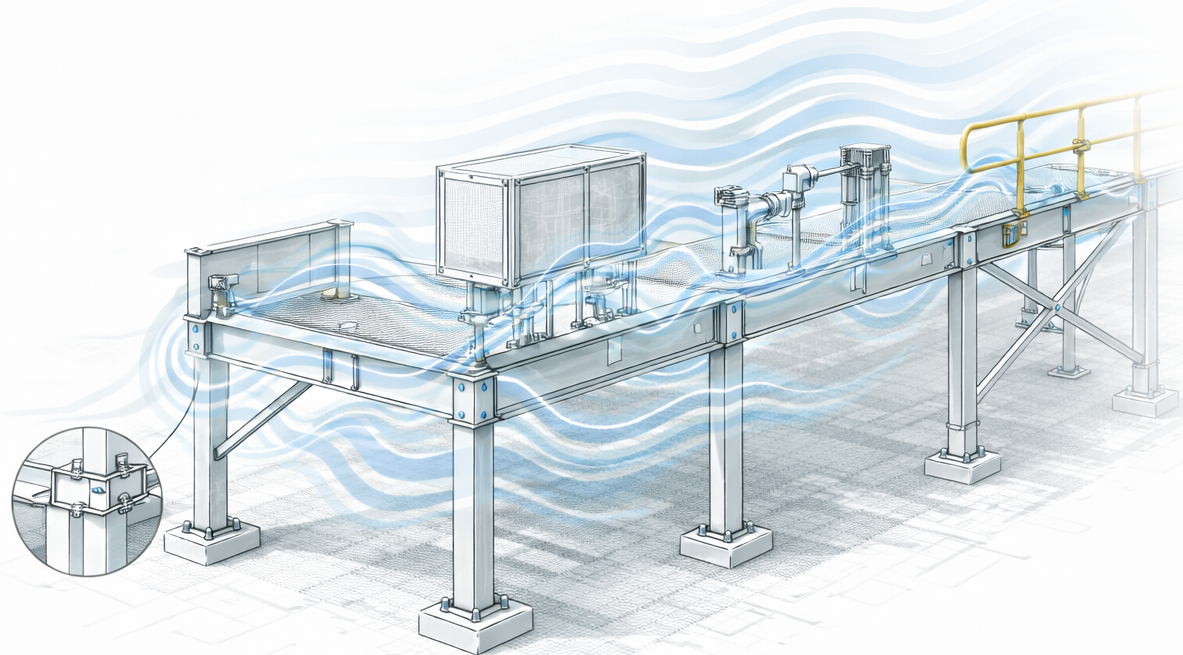
Not all vibration is harmful. Industrial facilities are dynamic by nature, and a certain level of motion is both expected and acceptable. Vibration becomes a problem only when it begins to govern behavior that static design does not capture.
The first threshold is often fatigue. Repeated stress cycles, even at low amplitude, accumulate damage over time. Welded details, attachments, stiffener terminations, and small-bore components are typically affected long before primary members show any signs of distress.
Noise is frequently the next indicator. Vibrating plates, ducts, and secondary elements convert structural motion into sound. What appears to be an acoustic issue is often a structural one in disguise.
As vibration persists, serviceability and operability are impacted. Bolted connections loosen, instruments drift, and maintenance demands increase. These effects occur well below strength limits and are rarely predicted by static analysis.
Finally, human perception sets its own limits. Vibration felt through floors, stairs, or handrails can become unacceptable due to discomfort or long-term exposure concerns, even when the structure remains structurally adequate.
These thresholds are context-dependent and often crossed after commissioning, as operating conditions evolve. Vibration does not suddenly become unacceptable — it transitions from background motion to governing constraint.
How a Structural Engineer Engages with Vibration
A structural engineer’s role in vibration problems is rarely to eliminate motion. It is to understand it, manage it, and decide when it matters.
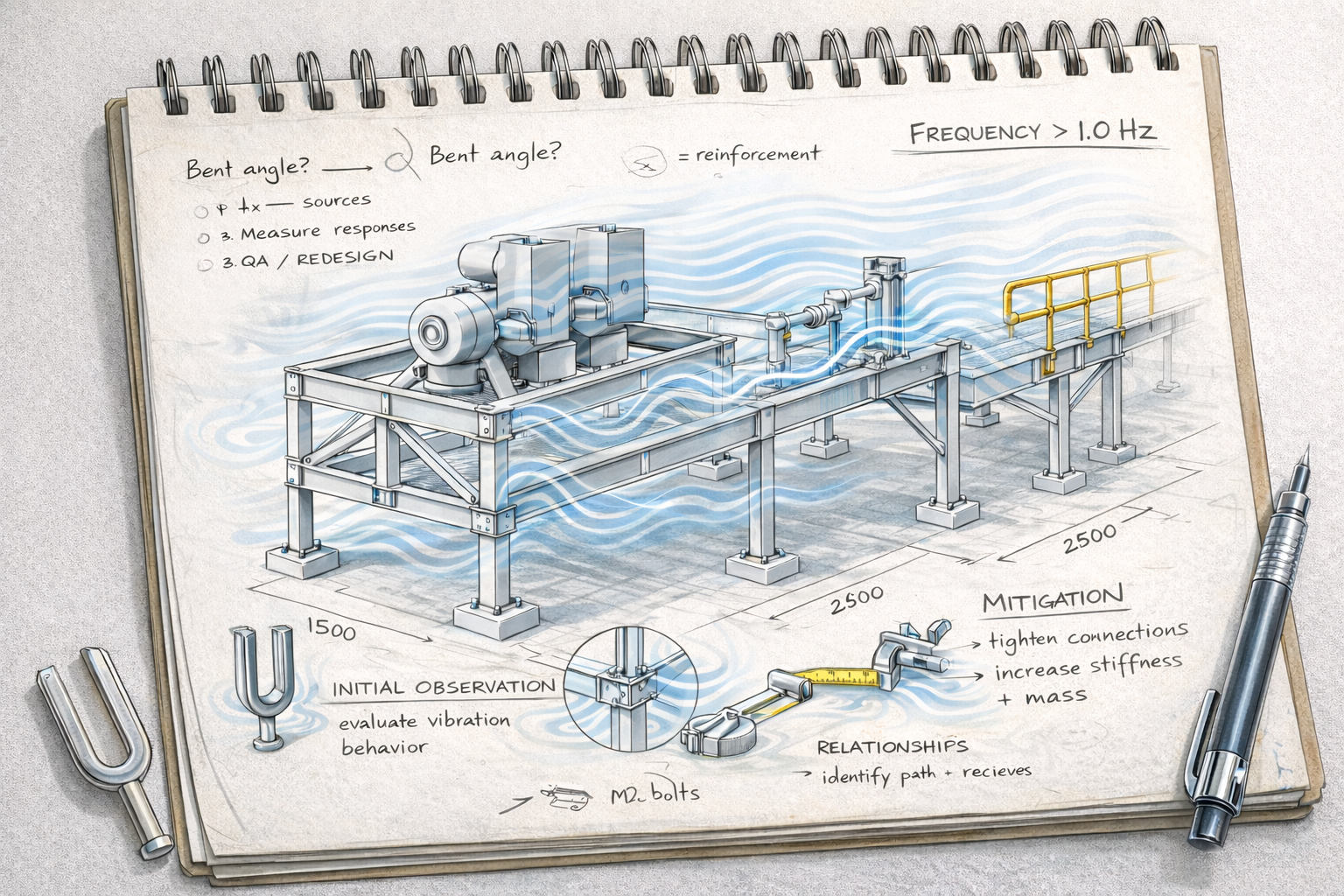
Engagement begins with observation, not calculation. Experienced engineers listen for noise, watch secondary elements, and note when vibration appears — during startup, partial load, or specific operating conditions. These early cues often reveal more than numerical models.
The next step is to frame the problem correctly. Rather than focusing on a single component, the engineer identifies the source, path, and receiver, and considers the frequency environment of the system. This reframing prevents misdirected solutions and clarifies which elements are dynamically coupled.
Analysis follows only after the system is understood. Simplified dynamic models, screening checks, or targeted measurements are often sufficient to identify governing mechanisms. Precision is applied where it adds value, not as a default response.
Mitigation strategies are then evaluated in terms of effectiveness and practicality. Adjusting stiffness, mass, damping, or connectivity may all be valid approaches, but none are universally correct. The goal is not to suppress all vibration, but to shift response away from sensitive components and unacceptable thresholds.
Finally, vibration is treated as a lifecycle issue. Operating conditions change, equipment ages, and process modifications accumulate. A structural engineer anticipates this evolution, favoring robust details, inspectable connections, and solutions that tolerate uncertainty rather than relying on perfect tuning.
In industrial structures, vibration is not a failure of design. It is a condition to be engaged with deliberately, using judgment informed by experience.
Conclusion
Industrial structures are often judged by what they can carry. In operation, they are defined by what they repeatedly endure.
Vibration does not challenge strength alone. It challenges assumptions — about stiffness, about adequacy, and about where problems originate. Many of the issues attributed to poor detailing or unexpected failures are, in reality, the predictable outcome of persistent dynamic excitation acting on sensitive structural elements.
Engaging with vibration effectively requires a shift in perspective. From loads to frequencies. From isolated components to systems. From static compliance to long-term behavior. This shift does not replace established design practice; it completes it.
In industrial facilities, structures are never truly still. Designing with that reality in mind allows engineers to anticipate problems, manage uncertainty, and create systems that remain functional, serviceable, and quiet long after commissioning.
Vibration is not an anomaly in industrial design. It is a condition. Recognizing when it matters — and how to respond — is part of structural engineering maturity.