
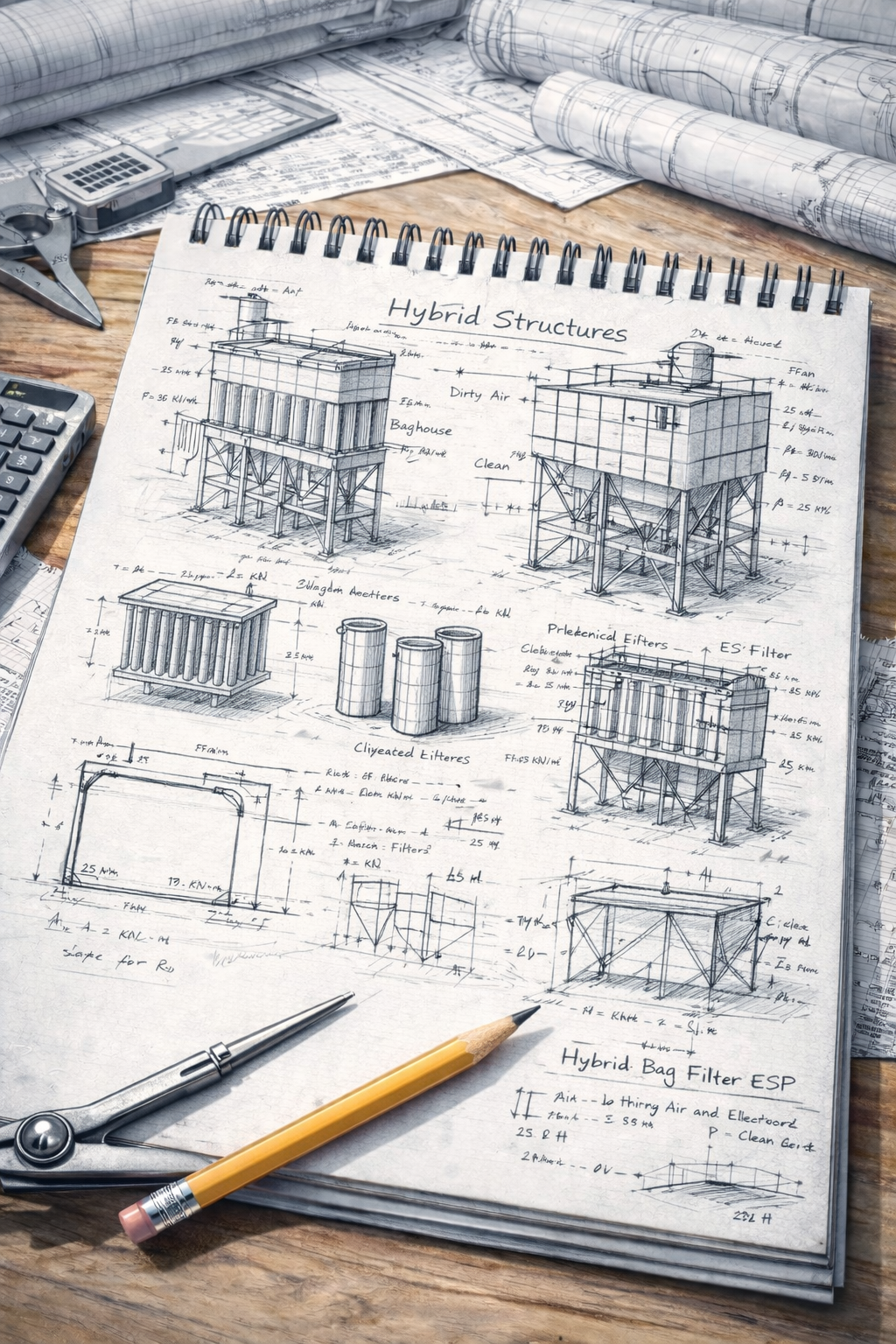
Hybrid Structures
Coupled structural–process systems with interacting behaviors
-
Hybrid structures are systems in which structural behavior cannot be separated from the function, operation, or geometry of supported process equipment. In these cases, the structure and the process system form a coupled whole, and engineering decisions must account for interactions that extend beyond conventional structural idealizations.
Typical applications
Baghouses and filtration units
Integrated process vessels with structural framing
Equipment supported by flexible or partially load-bearing shells
Systems where structural elements serve both support and containment roles
-
The performance of hybrid structures is governed by the interaction between multiple structural behaviors occurring simultaneously. Global framing response, local shell behavior, operational loads, and process-induced actions influence one another, often in non-intuitive ways.
Key governing aspects include:
Interaction between structural framing and supported equipment
Load sharing between primary and secondary structural elements
Sensitivity to operational, thermal, and maintenance-related actions
Compatibility of deformations between connected systems
In hybrid systems, simplifying assumptions that isolate individual components frequently lead to incomplete or misleading conclusions.
-
Engineering challenges in hybrid structures often arise from fragmented responsibility and incomplete system-level understanding, including:
Division of design scope between multiple disciplines or suppliers
Inconsistent assumptions regarding load transfer and stiffness
Difficulty defining governing load cases across operating scenarios
Limited guidance in codes for coupled structural–process behavior
These challenges demand a system-level perspective rather than isolated component checks.
-
Problems in hybrid structures rarely present as isolated structural failures. More commonly, deficiencies manifest through:
Incompatible deformations causing stress concentrations or leakage
Progressive deterioration at interfaces between structural and process components
Unexpected force redistribution following operational changes
Latent deficiencies revealed during maintenance or equipment replacement
Such issues often develop gradually and may remain undetected until system performance is compromised.
-
Rezali supports hybrid structures by adopting an integrated engineering perspective that considers the full system rather than individual components in isolation. Emphasis is placed on defining realistic load paths, deformation compatibility, and interface behavior between structural and process elements.
Typical involvement includes:
System-level structural modeling and assessment
Evaluation of load transfer mechanisms between components
Review of supplier and discipline interfaces
Independent technical review of complex hybrid systems
-
Where appropriate, this section may include:
Conceptual diagrams showing interaction between framing and equipment
Simplified system schematics highlighting load transfer paths
De-identified project photographs illustrating structural–process interfaces
Visuals should focus on interaction, not appearance.
-
Experience with hybrid structures consistently demonstrates that:
System behavior cannot be inferred from isolated component checks
Interface assumptions are often the governing risk
Operational and maintenance scenarios must be explicitly considered
Early system-level coordination reduces downstream uncertainty
These lessons inform Rezali’s approach to both new designs and independent reviews.
-
Even when primary systems are well understood, supporting and auxiliary structures can introduce disproportionate risk. The next section addresses secondary structures, where localized elements can govern overall reliability and safety.