
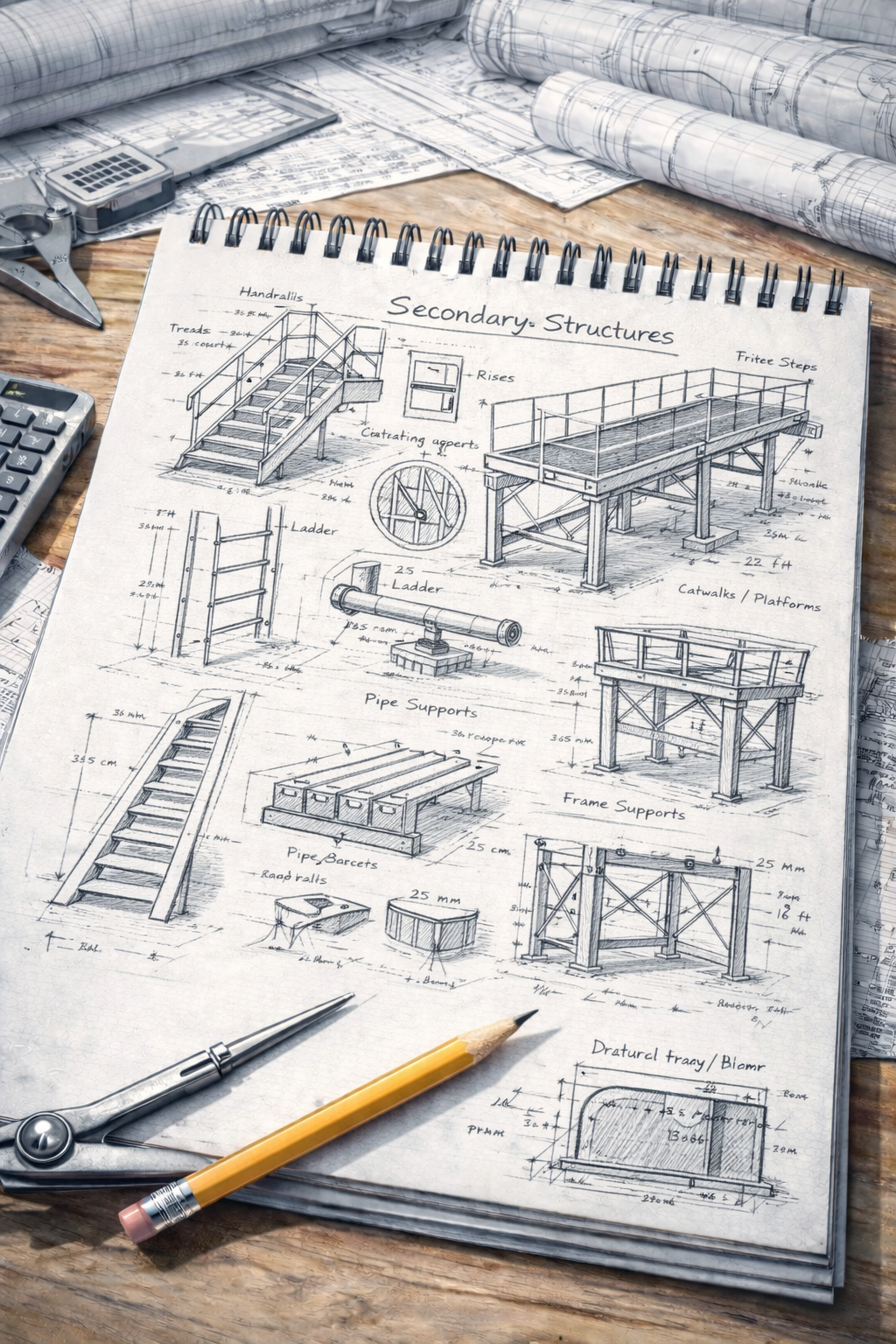
Secondary and Miscellaneous Structures
Localized elements with disproportionate consequences
-
Secondary and miscellaneous structures are elements that fall outside primary structural systems, yet are essential to access, operation, maintenance, and load transfer within industrial facilities. These structures often vary widely in form and function and are frequently introduced late in the design process, increasing the risk of incomplete engineering consideration.
Typical applications
Self-supporting and attached staircases
Access platforms, walkways, and catwalks
Intermittent supports for long or flexible systems
Localized frames, brackets, and equipment supports
Temporary, transitional, or non-standard structural elements
-
The behavior of secondary and miscellaneous structures is governed by localized load effects, connection behavior, and compatibility with adjacent systems. Because these elements often lack redundancy and are highly sensitive to boundary conditions, small changes in assumptions can lead to significant performance differences.
Key governing aspects include:
Load introduction through connections and attachments
Interaction with primary structures and supported systems
Serviceability, vibration, and human occupancy considerations
Fatigue and cumulative effects under repeated use or operation
-
Engineering challenges associated with secondary and miscellaneous structures often arise from their perceived simplicity or undefined scope, including:
Informal or undocumented loading assumptions
Ambiguity in design responsibility across disciplines
Limited consideration of temporary or maintenance conditions
Inconsistent application of serviceability and fatigue criteria
These challenges are frequently compounded by late-stage design changes or field-driven modifications.
-
Deficiencies in secondary and miscellaneous structures most commonly manifest as:
Excessive deflection or vibration affecting safety and usability
Connection failures due to underestimated localized forces
Progressive damage from fatigue or repeated loading
Unsafe conditions introduced by uncoordinated field alterations
Although rarely governing global structural stability, failures of these elements can have severe safety, operational, and liability consequences.
-
Rezali supports secondary and miscellaneous structures by applying the same engineering discipline used for primary systems, with particular emphasis on clarity of load paths, interface behavior, and realistic usage scenarios.
Typical involvement includes:
Structural design and verification of auxiliary elements
Review of connection detailing and attachment methods
Assessment of serviceability, vibration, and fatigue performance
Independent technical review of non-standard or miscellaneous structures
-
Where appropriate, this section may include:
Conceptual sketches illustrating load transfer through attachments
Diagrams highlighting interaction with primary systems
De-identified project photographs showing typical configurations
Visuals should emphasize localized risk and interface behavior, not scale or aesthetics.
-
Experience with secondary and miscellaneous structures consistently reinforces that:
Seemingly minor elements can govern safety outcomes
Connection detailing often controls performance
Temporary and maintenance conditions must be explicitly addressed
Early engineering involvement reduces downstream risk
-
Together, primary, hybrid, and secondary structural systems define how industrial facilities actually perform. Rezali’s engineering work across these categories is guided by an understanding of governing behavior, realistic assumptions, and the long-term consequences of engineering decisions.