
Thin-Walled Structures
Stability-governed systems sensitive to imperfections and load interactions
-
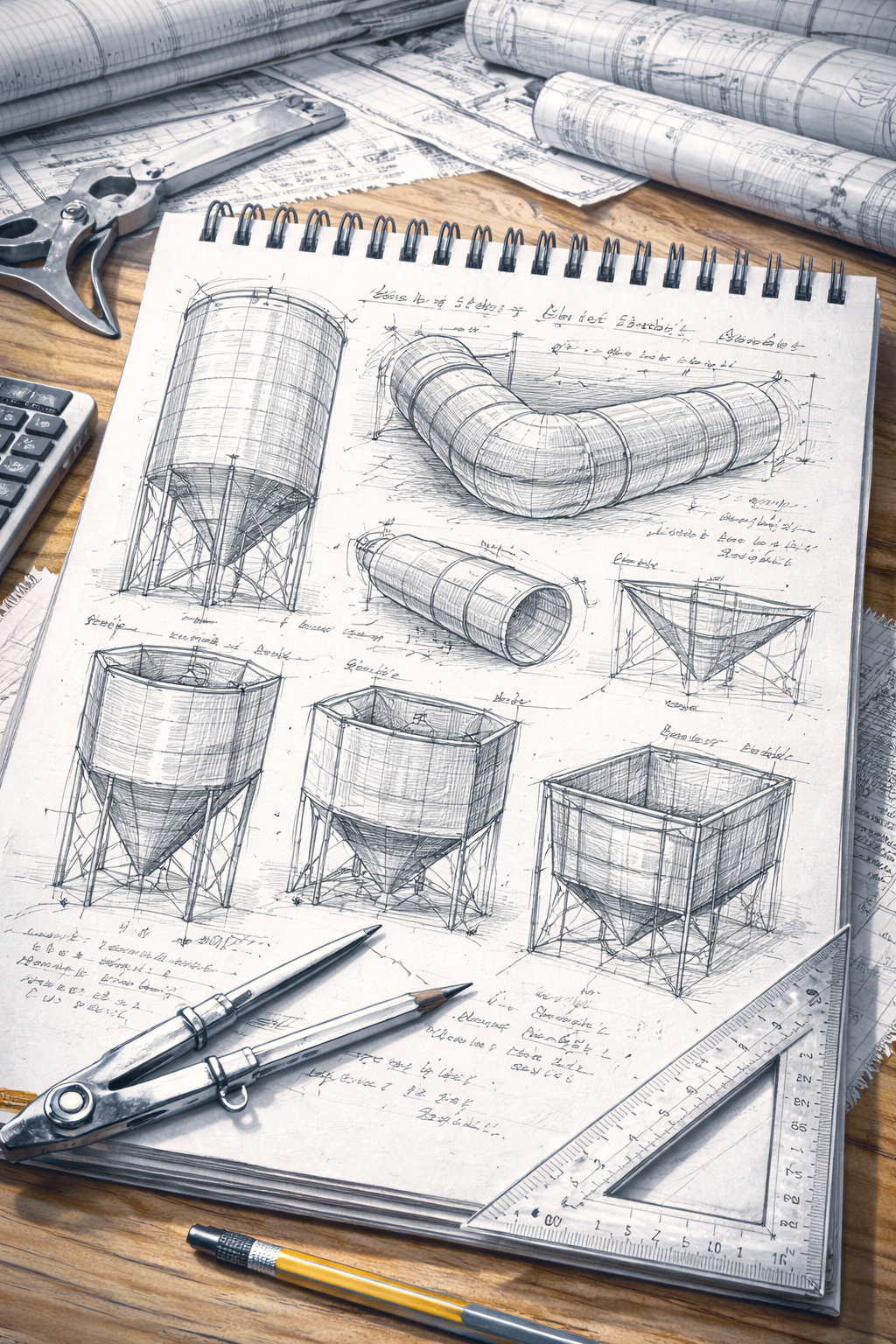
Thin-walled structures are widely used in industrial facilities to store, convey, or extract process materials and airflows. Unlike frame-type structures, their performance is rarely governed by member strength alone; instead, stability, geometric imperfections, and interaction between different load effects dominate their behavior.
Typical applications
Silos and bins for bulk solids
Ducts and stacks for air and gas handling
Hoppers and transition pieces
Shell-type process vessels and enclosures
-
The structural behavior of thin-walled systems is governed by buckling phenomena, shell action, and sensitivity to relatively small geometric deviations. Load combinations that appear secondary in conventional structures often become critical in thin-walled applications.
Key governing aspects include:
Local and global buckling behavior
Sensitivity to initial geometric imperfections
Interaction between gravity, pressure, wind, seismic, and thermal loads
Stress redistribution following local instability
Design adequacy is therefore highly dependent on correct modeling assumptions and realistic representation of boundary conditions.
-
Engineering challenges associated with thin-walled structures often arise from an underestimation of their sensitivity and complexity, including:
Reliance on idealized geometry not representative of fabricated reality
Incomplete consideration of load combinations governing instability
Misinterpretation or misuse of code-based buckling provisions
Difficulty reconciling analytical models with constructability constraints
These challenges require careful judgment beyond routine code application.
-
Problems in thin-walled structures frequently develop without obvious warning and may manifest as:
Local buckling leading to rapid loss of load-carrying capacity
Progressive deformation driven by imperfection amplification
Fatigue or cracking due to cyclic pressure or flow-induced effects
Unexpected load redistribution following localized instability
In many cases, deficiencies become apparent only after commissioning or during operation.
⚠️ This behavior underscores the importance of conservative assumptions and independent verification.
-
Rezali supports thin-walled structures through stability-focused analysis, careful interpretation of applicable standards, and engineering judgment informed by fabrication and operational realities. Particular emphasis is placed on identifying governing instability modes and validating assumptions related to geometry, support conditions, and load interaction.
Typical involvement includes:
Stability and buckling assessments
Review and validation of shell modeling approaches
Evaluation of code applicability and limitations
Independent technical review of critical thin-walled systems
-
Where appropriate, this section may include:
Simplified sketches of buckling modes
Conceptual shell behavior diagrams
De-identified project photographs illustrating geometry and support conditions
Visual material should clarify governing behavior rather than document appearance.
-
Experience with thin-walled structures consistently highlights that:
Stability considerations often govern over strength
Small geometric deviations can have disproportionate effects
Code compliance does not eliminate the need for engineering judgment
Early engagement reduces the risk of costly late-stage redesign
These lessons inform Rezali’s approach to both new designs and independent reviews.
-
Not all structures can be idealized as three-dimensional or shell-type systems. The next section addresses predominantly two-dimensional structures, where behavior is often governed by localized effects, dynamics, and support conditions.