
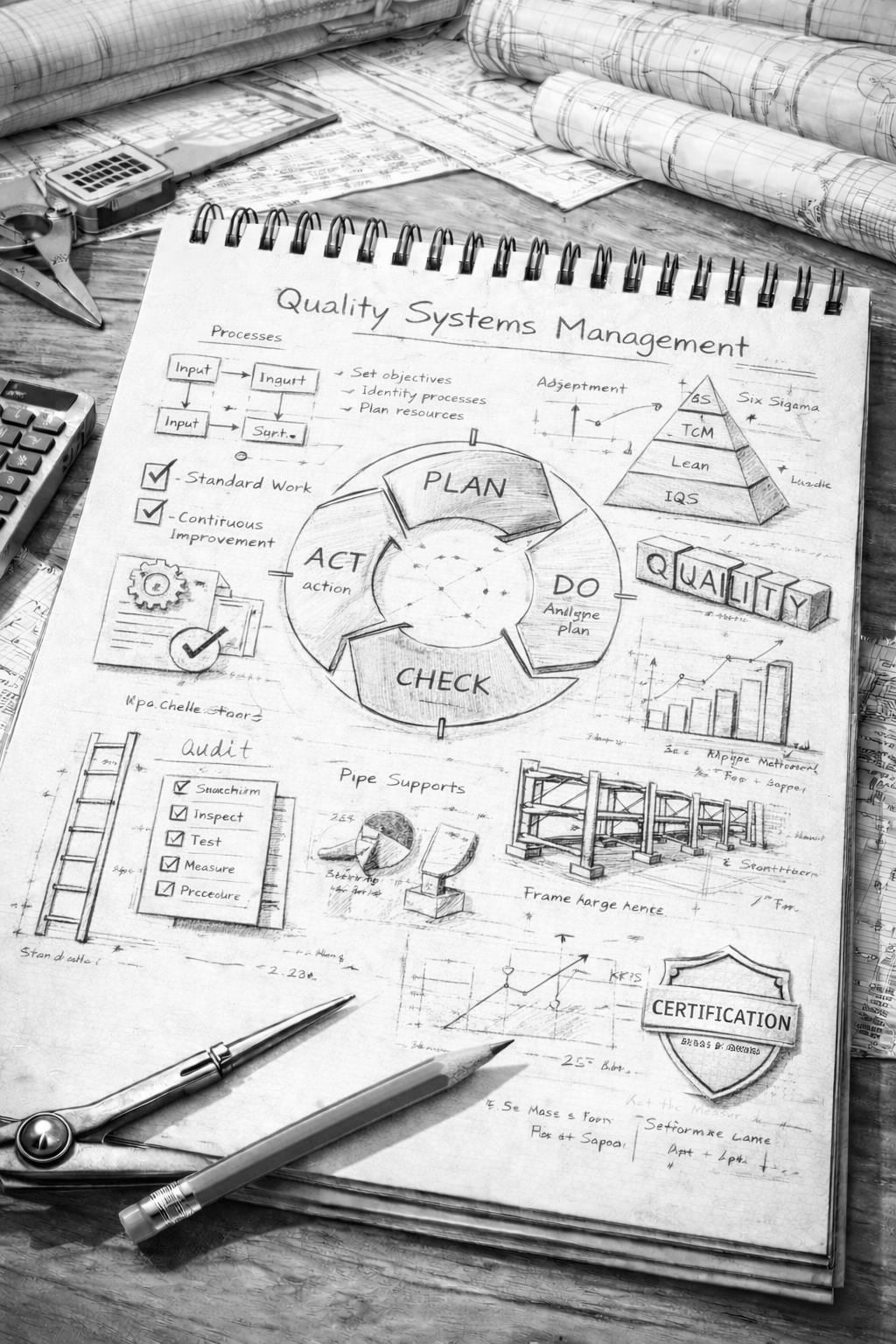
Rezali Quality Systems Management Services
Discuss Quality Systems for Your Organization or Project
Why Quality Systems Management Matters
For construction-related businesses and individual projects
-
Quality systems management (QSM) is often misunderstood as an administrative or compliance-driven activity. In construction-related industries, this misconception can lead to fragmented responsibilities, reactive problem-solving, and avoidable risk.
In reality, quality systems provide the organizational structure that allows engineering, procurement, fabrication, construction, and commissioning activities to function coherently. They define how decisions are made, how information is controlled, and how deviations are identified and addressed before they escalate into cost, safety, or liability issues.
-
Construction-related work involves:
Multiple disciplines and stakeholders
Sequential and interdependent activities
Long feedback loops between decisions and consequences
Without a structured quality system, organizations rely on individual experience and informal coordination to manage complexity. While this may work in limited or familiar contexts, it becomes increasingly fragile as project scale, technical complexity, or regulatory exposure increases.
Quality systems introduce:
Defined processes for critical activities
Clear roles and responsibilities
Consistent methods for planning, execution, and verification
This structure reduces reliance on ad hoc decision-making and improves organizational resilience.
-
At the organizational level, quality systems management supports construction-related businesses by:
1. Creating consistency across projects
Each project may be unique, but the way an organization plans work, controls documents, reviews designs, manages suppliers, and handles non-conformities should not be reinvented every time. Quality systems establish repeatable practices that improve predictability and performance.
2. Supporting accountability and traceability
When issues arise, quality systems make it possible to understand:
What was decided
By whom
Based on which information
This traceability is essential for internal learning, external audits, and contractual or regulatory review.
3. Managing risk proactively
Quality systems shift risk management from reactive problem-solving to early identification and control of potential issues. This is particularly important in construction environments where late-stage changes are costly and disruptive.
4. Enabling controlled growth
As organizations grow, informal coordination breaks down. Quality systems provide the framework that allows teams to scale without losing control over technical quality or decision-making.
-
Even organizations with established quality systems must adapt them to the realities of individual projects.
Project-specific complexity
Each project introduces:
Unique contractual requirements
Client-specific standards
Distinct technical and operational risks
Project-level quality systems translate organizational practices into project-specific controls, ensuring that expectations are clear and applicable to the work at hand.
Interface management
Projects involve interfaces between designers, contractors, suppliers, inspectors, and authorities. Quality systems define how information flows across these interfaces and how responsibilities are coordinated.
Control of change and non-conformities
Changes are inevitable in construction projects. Quality systems provide structured mechanisms to:
Evaluate changes
Assess technical and contractual impact
Implement corrective actions
Capture lessons learned
Without these mechanisms, projects drift into reactive mode, increasing uncertainty and exposure.
-
While many quality systems are aligned with standards such as ISO 9001, their value extends well beyond certification.
Effective quality systems:
Improve technical clarity
Support engineering judgment
Reduce rework and inefficiency
Strengthen client confidence
Certification may be a requirement in some contexts, but the underlying system is what delivers value on a day-to-day basis.
-
In construction-related businesses, quality systems are inseparable from engineering practice. Engineering decisions influence fabrication, construction, and long-term performance, and quality systems ensure that these decisions are:
Reviewed appropriately
Communicated clearly
Implemented as intended
This alignment is particularly critical for non-standard structures, complex assemblies, and projects subject to regulatory or third-party oversight.